from what country to what country does the suez canal
Maritime transportation has a vital office to play in our daily life as it benefits every single person beyond the globe. Despite the fact that the developments in the aviation manufacture take made the motion of people and goods faster, the shipping industry remains critical to the growth of economies.
As a backbone of international trade, freight transportation enables the movement of tonnes and thousands of goods- from toys to trucks- every day through the vast and unending oceans and seas.
Co-ordinate to the International Bedchamber of Shipping, the shipping manufacture, with more than over l,000 merchant ships offering service internationally, carries out virtually 90 per cent of world trade.
Related Reading: These Panama Canal Facts Will Surprise You
Even so, information technology's not only the diverse natural bodies that enable the international seaborne trade, but a number of human interventions in marine transportation besides strengthened the motion of people and goods worldwide.
The man-made canals in different parts of the globe have transformed the international shipping past shortening the shipping routes and reducing operating costs.
Currently, the major man-made canals across the world, such as the Panama Canal, Volga-Don Canal, the Corinth Culvert, the One thousand Canal and the Suez Canal, provide alternative transportation routes across major seawater networks across the world, facilitating efficient marine transportation.
Where is Suez Canal?
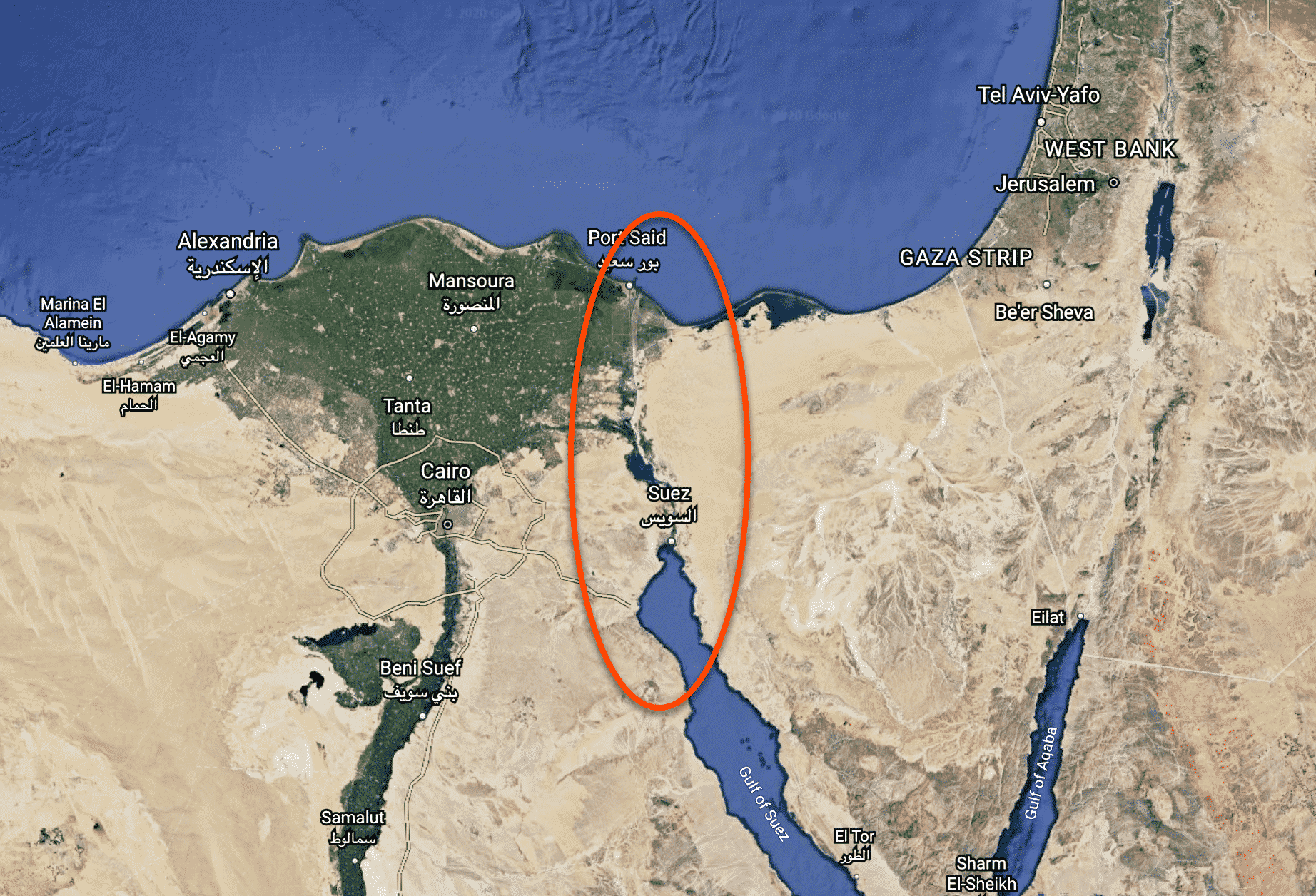
The 193.30 km (120 miles)-long Suez Culvert is an artificial sea-level waterway located in Arab republic of egypt and connects the Mediterranean Body of water with the Gulf of Suez, a northern branch of the Crimson Sea.
Officially opened in November 1869, the Suez Canal is one of the most heavily used shipping routes in the globe, witnessing the passage of thousands of vessels every year.
The canal, which separates Asia from the African continent, offers a shortest maritime road between Europe and the regions that share a edge with the Indian Bounding main and the Western Pacific Ocean.
The journey from Europe through the Mediterranean Sea and the Red Body of water, transiting through the Suez Canal, cuts around seven,000 kilometres off the journey compared to the one carries out through the Due south Atlantic and southern Indian oceans. The culvert also connects the Port Said in northeast Egypt with Port Tewfik at the city of Suez in the south.
The construction of the Suez Culvert was carried out betwixt 1859 and 1869 past the Suez Canal Company, and the Suez Canal Potency owns and maintains the waterway.
In 2015, Arab republic of egypt completed a major expansion of the Suez Canal that saw the deepening of the parts of the canal and the construction of a second 35km-long shipping lane along office of the master waterway.
The expansion allowed the canal to conform two-way traffic along function of the route and too the transiting of larger vessels. In December 2017, the earth'south largest container ship, the 400-meter long OOCL Hong Kong, passed through the Suez Canal carrying 21,400 containers.
Witnessing effectually 8 percent of global ocean-borne trade annually, the canal plays a significant role in the growth of Egypt's economy. Co-ordinate to Reuters, the Suez Canal generated revenue of $5.3 billion in 2017.
Though the Suez Culvert wasn't formally completed until 1869, in that location is a long history of notice in connecting both the Nile River in Egypt and the Mediterranean Ocean to the Reddish Bounding main.
The history of the Suez Canal dates back to around xl centuries every bit the idea of linking the Red Sea with the Mediterranean Ocean emerged during the period of the Pharaohs of Ancient Egypt.
The concept of a canal that connects these seas and the Nile River lasted until the construction of the first canal in the area, linking both the seas through Nile River under the reign of Senausret III, Pharao of Egypt (1887-1849 BC). Notwithstanding, the canal was often abased during many years following the construction.
At the same time, the canal was as well reopened several times for navigation under the reign of various rulers including Sity I (1310 BC), Necho Ii (610 BC), Farsi King Darius (522 BC), Emperor Trajan (117 AD) and Amro Ibn Elass (640 AD), amid others.
The historic documents suggest that the canal was extended, and several other attempts to build new canals were likewise carried out during these periods.
The beginning modernistic effort to build a canal came in the late 1700s, during Napoleon Bonaparte's Egypt trek. He believed that building a French-controlled canal on the Isthmus of Suez would cause trade bug for the British every bit they would either have to pay dues to France or continue sending appurtenances over state or around the southern part of Africa.
Studies for Napoleon'southward canal plan began in 1799, simply a mistake in measurement showed the sea levels betwixt the Mediterranean and the Reddish Seas as beingness too different for a canal to be viable and construction was immediately stopped.
With the rise of new Europe and the development of manufacture and seaborne trade, entrepreneurs began to think of building canals. I such program aimed at connecting the Scarlet Sea with the Mediterranean Ocean directly, thus saving time either to sail around Africa or transhipping freight or passengers beyond the Suez Peninsula.
The adjacent attempt to build a canal in the area occurred in the mid-1800s when a French diplomat and engineer, Ferdinand de Lesseps, convinced the Egyptian viceroy Said Pasha to support the edifice of a canal.
In 1858, the Universal Suez Ship Culvert Company (La Compagnie Universelle du Culvert Maritime de Suez)was formed and given the correct to brainstorm construction of the canal and operate it for 99 years, after which time, the Egyptian government would take over command of the canal.
How Ships Transit Suez Canal?
Structure of the Suez Canal
The structure of the Suez Canal officially began on April 25, 1859. It was estimated that a total of two,613 1000000 cubic feet of world- 600 million on country and 2,013 million through dredging- would have to be moved for building the canal. Furthermore, the total original cost of the projection was estimated at 200 1000000 francs.
The conclusion to build a canal connecting the Mediterranean and the Scarlet Body of water, yet, invited criticism from Briton, which considered the project as a political scheme fix upward to weaken the country's dominance in seaborne merchandise.
United kingdom connected to oppose the projection until the Empire bought a 44 per cent stake in the culvert after the Egyptian government auctioned off its shares in 1875 due to fiscal bug.
Initially, the construction of the canal was carried out past forced labourers. It is said that thousands of people were forcefully assigned to dig the canal using picks and shovels until Pasha banned the apply of forced labour in 1863.
This compelled the Suez Canal Company to bring custom-made steam and coal-powered shovels and dredgers to build the culvert.
With the help of this machinery, the project received the boost it required and allowed the waters of the Mediterranean flow into the Red Sea through the canal on November 17, 1869.
When it opened for the navigation, the Suez Canal was 200 to 300 feet wide at the surface, 72 feet wide at the bottom and 25 feet deep. At the time of completion, the total cost of the project was more than than twice the original estimates.
The Suez Canal and Political Crises
Later completion of the project, the Suez Culvert had a significant impact on world trade despite the traffic through the waterway was below expectations in the initial years.
Meanwhile, the fiscal bug linked with the construction of the canal allowed the British government to buy the stakes owned by Egyptian interests in 1875 to go the major shareholder in the Suez Canal Visitor.
The canal was vital to the British economy every bit it provided a shorter body of water route to its colonies and the oilfields of the Persian Gulf.
Britain strengthened its control over Arab republic of egypt in 1875 when the latter went broke, allowing the banks in Europe to take control of the state financially.
Equally the French and British continued their command over the state, it started resentment among the Egyptians. This acquired Brittan to invade Egypt in 1882.
Though Arab republic of egypt remained virtually independent due to the Anglo-Egyptian treaty of 1936, Britain took complete control of the Suez Canal. During the First World State of war, Britain appear Arab republic of egypt a protectorate and sent forces to protect the culvert, and this lasted till 1922 when Britain provided nominal independence to Egypt.
Though the Anglo-Egyptian Treaty declared Egypt equally a sovereign state in 1936, Uk merely agreed to withdraw its troops from Egypt in 1956.
The major political unrest linked to the Suez Canal, known equally the Suez Crisis, started in July 1956, when the then Egyptian President Gamal Abdel Nasser nationalized the Suez Culvert and closed the Straits of Tiran.
The decision resulted in the invasion of Egypt past the UK, France, and Israel. It was simply after the intervention of the United Nations, the three forces withdrew from Egypt, allowing the state to reopen the canal for commercial shipping.
The political unrest, however, connected for a long future and the canal was shut down by the Egyptian authorities in 1967 during the Half dozen-mean solar day State of war betwixt Israel and Egypt.
The endmost of the canal also led to the stranding of 15 aircraft vessels in the middle of the culvert, at the Great Bitter Lake. These vessels, known as Yellow Fleet, remained trapped at that place till 1975 later Arab republic of egypt reopened the Suez Canal subsequently peace talks with Israel.
Since then, the canal remains a significant ship link betwixt the Mediterranean and Red Seas, allowing the international ships to avoid the hard voyage effectually the southern tip of Africa.
The world longest canal without a lock, co-ordinate to the Suez Culvert Authorisation, expects to raise the daily boilerplate of travelling vessels to 97 ships ad revenue of $ 13.226 billion by the year 2023.
Suez Culvert Map
Y'all might as well similar to read:
- Acme 10 Books on the Panama Culvert
- The Corinth Canal: A Narrow Man-Made Shipping Culvert
- x Famous Shipping Canals of the Earth
- The Panama Canal Expansion Project and Its Benefits to the Shipping Industry
- x Of import Panama Canals Facts Anybody Should Know
Disclaimer: The authors' views expressed in this article do not necessarily reverberate the views of Marine Insight.Data and charts, if used, in the article have been sourced from available information and have not been authenticated by any statutory authority. The author and Marine Insight do not claim it to be accurate nor take any responsibility for the same. The views establish only the opinions and exercise not constitute any guidelines or recommendation on any grade of action to be followed by the reader.
The article or images cannot exist reproduced, copied, shared or used in any form without the permission of the writer and Marine Insight.
Source: https://www.marineinsight.com/maritime-history/a-brief-history-of-the-suez-canal/
0 Response to "from what country to what country does the suez canal"
Postar um comentário