What Means if Ohmmeter Reads 2.8 ̉ۡ Resistance Between the Terminal C and the Shell of the Motor
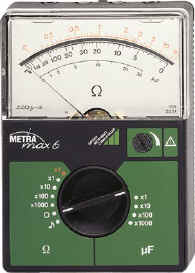
An ohmmeter is an electrical instrument that measures electrical resistance (the opposition offered by a circuit or component to the menstruation of electrical current). Multimeters likewise function equally ohmmeters when in resistance-measuring way. An ohmmeter applies electric current to the circuit or component whose resistance is to be measured. It and then measures the resulting voltage and calculates the resistance using Ohm's law .

An ohmmeter should not be connected to a circuit or component that is conveying a current or is continued to a ability source. Ability should exist disconnected before connecting the ohmmeter. Ohmmeters can be either connected in series or parallel based on requirements (whether resistance beingness measured is role of circuit or is a shunt resistance.)
Micro-ohmmeters (microhmmeter or micro ohmmeter) make measurements of low resistance. Megohmmeters (also a trademarked device Megger) measure large values of resistance. The unit for resistance is the ohm (Ω).
Design development [edit]
The first ohmmeters were based on a blazon of meter movement known as a 'ratiometer'.[1] [2] These were similar to the galvanometer type movement encountered in subsequently instruments, just instead of hairsprings to supply a restoring force they used conducting 'ligaments'. These provided no net rotational forcefulness to the movement. Too, the movement was wound with two coils. Ane was connected via a series resistor to the battery supply. The second was continued to the same battery supply via a 2d resistor and the resistor under test. The indication on the meter was proportional to the ratio of the currents through the two coils. This ratio was determined past the magnitude of the resistor under examination. The advantages of this arrangement were twofold. First, the indication of the resistance was completely independent of the battery voltage (equally long as it actually produced some voltage) and no nix adjustment was required. Second, although the resistance scale was non linear, the calibration remained right over the full deflection range. By interchanging the 2 coils a 2nd range was provided. This scale was reversed compared to the first. A feature of this type of instrument was that it would continue to indicate a random resistance value in one case the test leads were disconnected (the action of which disconnected the battery from the motion). Ohmmeters of this type only e'er measured resistance as they could not easily be incorporated into a multimeter design. Insulation testers that relied on a hand cranked generator operated on the same principle. This ensured that the indication was wholly independent of the voltage actually produced.
Subsequent designs of ohmmeter provided a minor battery to use a voltage to a resistance via a galvanometer to measure the current through the resistance (battery, galvanometer and resistance all connected in serial). The calibration of the galvanometer was marked in ohms, because the fixed voltage from the bombardment assured that as resistance is increased, the current through the meter (and hence deflection) would subtract. Ohmmeters grade circuits by themselves, therefore they cannot be used within an assembled circuit. This blueprint is much simpler and cheaper than the former design, and was uncomplicated to integrate into a multimeter blueprint and consequently was by far the most common form of counterpart ohmmeter. This type of ohmmeter suffers from two inherent disadvantages. Get-go, the meter needs to be zeroed by shorting the measurement points together and performing an adjustment for zero ohms indication prior to each measurement. This is because as the bombardment voltage decreases with age, the series resistance in the meter needs to be reduced to maintain the zero indication at full deflection. Second, and consequent on the first, the actual deflection for any given resistor under test changes as the internal resistance is altered. Information technology remains right at the centre of the calibration only, which is why such ohmmeter designs always quote the accurateness "at middle scale merely".
A more accurate blazon of ohmmeter has an electronic circuit that passes a abiding electric current (I) through the resistance, and another circuit that measures the voltage (Five) beyond the resistance. These measurements are so digitized with an analog digital converter (adc) afterward which a microcontroller or microprocessor make the partitioning of the current and voltage co-ordinate to Ohm'south Constabulary and so decode these to a brandish to offering the user a reading of the resistance value they're measuring at that instant. Since these type of meters already measure current, voltage and resistance all at once, these type of circuits are oft used in digital multimeters.
Precision ohmmeters [edit]
For high-precision measurements of very small resistances, the above types of meter are inadequate. This is partly considering the change in deflection itself is small-scale when the resistance measured is as well small in proportion to the intrinsic resistance of the ohmmeter (which can be dealt with through electric current sectionalisation), simply more often than not because the meter's reading is the sum of the resistance of the measuring leads, the contact resistances and the resistance being measured. To reduce this effect, a precision ohmmeter has four terminals, called Kelvin contacts. 2 terminals carry the current from and to the meter, while the other ii allow the meter to mensurate the voltage across the resistor. In this system, the power source is connected in series with the resistance to be measured through the external pair of terminals, while the 2d pair connects in parallel with the galvanometer which measures the voltage drop. With this type of meter, any voltage drop due to the resistance of the first pair of leads and their contact resistances is ignored past the meter. This iv concluding measurement technique is called Kelvin sensing, afterwards William Thomson, Lord Kelvin, who invented the Kelvin span in 1861 to mensurate very depression resistances. The Iv-terminal sensing method can also be utilized to behave accurate measurements of low resistances.
References [edit]
- ^ http://www.g1jbg.co.uk/pdf/MeggerBK.pdf Archived 2012-03-15 at the Wayback Machine A pocket book on the use of Megger insulation and continuity testers.
- ^ http://www.prolexdesign.com/images/evohmmeter.jpg [ permanent dead link ] Illustration of blazon. Note the absence of any zero adjustment and the changed scale direction between ranges. [ expressionless link ]
https://www.codrey.com/electrical/ohmmeter-working-and-types/
External links [edit]
 | Wikimedia Commons has media related to Ohmmeters. |
- DC Metering Circuits chapter from Lessons In Electric Circuits Vol 1 DC free ebook and Lessons In Electrical Circuits series.
Source: https://en.wikipedia.org/wiki/Ohmmeter
0 Response to "What Means if Ohmmeter Reads 2.8 ̉ۡ Resistance Between the Terminal C and the Shell of the Motor"
Postar um comentário