Best Fiction Books for Writers to Read
Welcome toThe Writing Jitney. On this podcast, I speak with the instructors, editors, coaches, and mentors who help writers and authors create their fine art, build their audience, and sell their work.
A client of mine recently asked me what novels I would recommend for the purpose of demonstrating different aspects of writer's craft.
This episode answers that question by revealing 13 novels every author should read!
Listen to the podcast now at present or read the full transcript below.
Episode Transcript
How-do-you-do dearest listeners and welcome back to The Writing Coach podcast. I am your host Kevin T. Johns.
If this is your first time listening to the podcast, welcome. We love new listeners. This is episode … oh boy, I always forget to bank check before we start recording. It's probably episode 59 or 60 or something, which ways if you enjoy this episode there'due south another 58, 59 episodes out there that you tin can become check out where I conversation with all sorts of amazing people. Shawn Coyne, Jenny Blake, Chandler Commodities. Everyone in the world of helping authors. Tons of smashing interviews in there with people similar Jeff Goins. Everyone you lot want to hear me chat with, I chat with. Go dorsum. Dig into those athenaeum and check out some of those older episodes.
Normally, I interview someone else, just every in one case in a while, like actually the last few episodes, it's just me. This is going to be another i of them considering of ane of my one-on-one coaching clients … I'm a writing motorcoach guys. It's not merely a title of a podcast. It's something I do professionally. 1 of my clients asked me a really smashing question. I gave it a lot of thought. I decided I was going to answer him in podcast format. Reza, you lot are probably listening to this. Thank you then much for asking such a great question. We are going to get to it in a minute.
Reza is one of my one-on-i clients. I have a couple other one-on-one clients who have come on board as of late. Peter if yous are listening to this, and Attila — welcome aboard guys. I tin can't wait to piece of work with you to go your books written.
This episode is going to address a very specific question that Reza asked. Reza grew up in Islamic republic of iran and came to Canada, where I live 10, years ago. He's really been focusing on his English writing for the concluding ten years. He's ever been very interested in not-fiction. That's the type of writing he does. He's writing a nonfiction self-help book. He said, "Kevin, if I did want to kickoff exploring English fiction, what would be some peachy books I could read that could help me understand writing better?"
I thought that was such a smashing question!
That's what we are going to get into in today's podcast. We are going to talk about thirteen different books that I think every author should read. Each of these books is going to demonstrate a different attribute of a author'due south arts and crafts that I remember is really of import.
Before we get into that, I do want to say this is not a conversation about overturning the cannon of traditional English language literature. This is a podcast episode almost author's craft. Alright? From the hundreds and hundreds of books I've read in my life, these were the books that came to heed as great examples, the all-time examples in dissimilar aspects of the arts and crafts of novel writing.
I will warn you, well-nigh of the authors I have chosen are white, heterosexual, American men. I'grand not going to apologize for my bias. I like what I like, only I volition admit my biases. I'thousand a left-leaning, white, heterosexual, Canadian, male with a masters degree in English language literature. All of my book choices are going to exist biased by that position of privilege that I'chiliad coming from. I do want to acknowledge that.
If you are listening to this and you are an Aboriginal person or you are a gay man or you are a adult female for whom English is not your first linguistic communication, by all means, create your own list of your favorite examples of different aspects of the writer'due south arts and crafts. These just happen to be the people who I resonate with, who I've read in my life, and who spring out at me as keen examples of different aspects of writing.
With that politically correct public service announcement out of the way, permit's dive into some slap-up books that every unmarried writer should read.
The Peachy Gatsby / Tender is the Dark by F. Scott Fitzgerald
Lightning in a Bottle
Right off the bat, nosotros are going to kick it off with maybe the biggest of them all. The Great Gatsby by F. Scott Fitzgerald.
Why should you read this volume? Information technology'southward the bang-up American novel. It is beautifully written. Brilliantly plotted. The characterization is crystal articulate. There are surprising plot twists, but on superlative of all of that, it's one of those rare things in art. It'southward one of those things that every artist strives after: that magical slice of art where everything just works. Everything gels for where Fitzgerald was in his life. For the story that he chose to tell. Everything comes together in The Great Gatsby to piece of work perfectly.
I'grand going to throw a twist on this for you. I don't want you just to read The Great Gatsby. I likewise want you to read F. Scott Fitzgerald'due south follow up to The Cracking Gatsby, which is Tender is the Night. There's a reason for that.
In the exact same way that everything works in The Smashing Gatsby, just every aspect of it is sublime, aught works in Tender is the Dark. Tender is the Night is a disaster of a book. It's the follow-up to what I would probably debate is the greatest American English novel of all time.
A lot of writers that I know, they practise this thing where they compare themselves not merely to the greatest writers of all time, but they look at the one masterpiece from the greatest writer of all time. If you are going to sit at home and say, "Oh my God, my novel is a piece of crap compared to The Great Gatsby." You lot know what? It probably is, but F. Scott Fitzgerald'south follow-up was also a piece of crap in comparing to The Swell Gatsby.
I actually think it's important that as a writer you lot understand there is craft. At that place is technique. There's hard work. There's going pro. There is all of that, but there also is a magical element. Fitzgerald couldn't recreate information technology. None of u.s. can. If we could all recreate it, we'd all take hit books year afterward year later yr, simply there is something magical that comes together in The Great Gatsby that is just the complete opposite in Tender is the Night.
Read both those books so that you lot can sympathise non simply the genius of The Great Gatsby, but also was a fluke it was, arguably, compared to Fitzgerald's follow-upwards book.
The Catcher in the Rye past J.D. Salinger
Point of View
The next volume that I want to recommend is The Catcher in the Rye by J. D. Salinger.
I picked this book because ane of the biggest challenges I meet aspiring novelists struggling with is point of view.
Point of view is such a catchy element of writing. A lot of kickoff time novelists go into writing a book not even really understanding what information technology is or how it functions. They practice a lot of head-hopping or they jump back and forth betwixt third person or omniscient. They are not witting of the part the indicate of view plays in narrative fiction.
The Catcher in the Rye is an absolutely wonderful instance of an author capturing a character'south point of view. Holden Caulfield is our main character in The Catcher in the Rye and everything nosotros experience every bit readers in that volume is filtered through Holden'southward point of view. At that place is non an omniscient narrator. Salinger didn't choose to take God upwardly in the sky looking downwardly on New York and narrating Holden'south adventures. We are there within Holden's caput, experiencing the journey with him and the linguistic communication that Salinger uses, information technology isn't Salinger's language. It's Holden'southward language. The way New York is described is the language Holden would use to describe New York, non J. D. Salinger.
That very important chemical element of point of view is captured perfectly in The Catcher in the Rye.
Fear and Loathing in Las Vegas by Hunter South. Thompson
Attitude and Vocalization
Fright and Loathing in Las Vegas by Hunter S. Thompson is one of my favorite books. It's what I would signal people to when they are talking virtually "vox" or "authorial vocalism."
People are often a footling as well obsessed with vocalism and what is their writerly voice. So you can expect to the writing of Hunter Due south. Thompson for an example of writer whose voice is different from every other writer'south. I tin can read a piece of writing from Hunter Southward. Thompson and know that it's Hunter S. Thompson without anyone telling me. There's very few writers that yous could say that most.
I was witting of following up The Catcher in the Rye with Fear and Loathing in Las Vegas considering J.D. Salinger was a author for The New Yorker magazine. The New Yorker, to a certain extent, defined a certain style of writing and liberal intellectual approach to literature in New York City for a lot of the 20th century. I like to compare that to Hunter S. Thompson, who is this other voice.
Thompson is the outsider voice. He wrote Fear and Loathing in Las Vegas for Rolling Stone magazine. This was a Rock n' Roll journalist writing for a counter culture mag. I remember for all of the dazzler and intelligence and wit that you lot are going to detect in the work of Salinger, you are going to find energy and rage and merely in your face up energy and attitude coming out of Hunter Southward. Thompson'southward writing. I highly recommend checking it out.
Mrs. Dalloway by Virginia Woolf
Poetic Luminescence
It'due south so difficult to answer the question, "What's your favorite book of all time?" Simply when I have to settle on a single volume, it's Mrs. Dalloway past Virginia Woolf.
If yous found out you had three days to live and yous only had one book to read in those final 3 days of your life, I'd want you to read Mrs. Dalloway.
Information technology captures everything. It takes all of existence and, in a narrative that takes place over a single solar day with only a scattering of characters, somehow captures the psychological complexity of human existence within a book that is just absolutely beautifully written.
You are never going to notice a book with more gorgeous sentences than Mrs. Dalloway by Virginia Woolf. That's the case that I would wait to if you want to see poetic writing at its all-time. And if you desire to see psychological complexity at its best.
If you want to meet just amazing literature, Mrs. Dalloway is where I would send you. Go check that one out.
Ane Hundred Years of Solitude by Gabriel Garcia Marques
Manipulation of Time
Here's another one where my side by side recommendation plays off of the last i. Mrs. Dalloway takes place over a single day. It's an case of how storytellers can actually deadening downwards time and really appreciate every petty corn horn beeping on the street or every little interaction of ownership flowers. That'south what Mrs. Dalloway is well-nigh. It'south nearly taking the small things in life and turning them into magic. Now I desire to contrast that withI Hundred Years of Solitude by Gabriel Garcia Marquez.
One Hundred Hundred Years of Confinement, every bit the title suggests, takes place over decades and decades. It covers seven generations in a family unit. While Virginia Woolf chose to focus an entire novel on a unmarried mean solar day, and largely two or 3 principal characters, Marquez covers a hundred years and 7 generations of this single family unit.
And then on peak of that at that place's a lot of really fascinating non-linear story telling going on. The style ofAne Hundred Hundred Years of Solitude is chosen "magical realism." There's some really fascinating moments where Marquez will exist with one graphic symbol and say, "Fifty years later such and such happened to that character." Then 300 pages subsequently that affair happens.
Information technology's hard to convey quickly like this, just there'due south some amazing piece of work going on with the bending and folding of fourth dimension inAne Hundred Years of Solitude. It'south such a great instance of how using language, we can skip ahead a hundred years and and then come up back and afterwards on the same 2nd for ten pages.
Time is very flexible in fiction. Whether it's Mrs. Dalloway or whether it'sAne Hundred Years of Solitude, those are two nifty examples of how you tin can play with time equally a writer.
A Farewell to Arms by Ernest Hemingway
Minimalism
Next up, A Goodbye to Arms by Ernest Hemingway. I retrieve of A Bye to Arms equally almost … it's like Mrs. Dalloway and A Farewell to Arms are somehow opposite ends of the same spectrum. Both somehow capture love, death, war, humanity and bring all these things together into a single book.
While Woolf captures those things by playing with language and creating these turns of phrase in these long flowing sentences, Hemingway captures it all the exact opposite: by beingness super minimal.
If yous as a writer are trying to make that decision most your style, those are two books you could look to. Inquire yourself, exercise I desire to exist a writer more than like Virginia Woolf and have these poetic long flowing sentences or do I want to be a writer like Hemingway and tell things really dry and really straightforward?
I would argue both of those books, Mrs. Dalloway and A Bye to Arms, are devastating. They are both hugely powerful works that just took my heart, grabbed a hold it, and then broke information technology in half. They achieved that impact on me in totally different means.
Y'all, equally a author, will have to practice some thinking near what is going to be your manner. What'due south going to be your approach to tearing out my heart and breaking it in half?
Lolita by Vladimir Nabokov
Bridging Literary and Commercial Fiction
Next upwards is Lolita by Vladimir Nabokov. This is actually a book I didn't read in University or as a teenager. Due to its subject field thing, I was always turned off to the idea of it for obvious reasons.
For those of yous who aren't familiar with information technology, the protagonist is a pedophile. Not exactly something you would think would be fun, light reading and yet Nabokov with Lolita has somehow created this perfect bridge between literary fiction — all this beauty and intelligence that nosotros are talking virtually in something similar Mrs. Dalloway or fifty-fifty A Farewell to Arms — and commercial fiction, which I really too beloved. The fast pace. The edge of your seat story telling. Almost over the top or even appalling bailiwick matter and moments of funniness assorted with moments of violence and despair and, well, everything. Everything.
Some of these books, what I love most them so much is they capture so many aspects of life all in one unmarried narrative. I would say, if y'all were a writer, if you said "I really honey great literature or actually stiff linguistic communication, bully writing, but I also want to have a book that they are going to brand a movie of anytime and that I can give to my mom to read or something…" Well, I mean, no, Lolita is non an instance of that, but it is a adept example of a book that bridges that gap betwixt literary great writing, but too all of the things y'all would await for in a mainstream thriller novel, which is great story telling. Great twists. Edge of your seat stuff.
On the Road by Jack Kerouac
Stream of Consciousness
Next upward, On the Road by Jack Kerouac.
This is just a cracking case of the stream of consciousness arroyo to literature and to writing. This is the idea of getting it out of your body and onto the folio. I call up there's probably a lot more revision and editing that actually went on than we like to pretend with Kerouac, only, all the same, a lot of the writers I work with deal with blocks. They deal with 2nd-guessing. They deal with trying to get everything correct kickoff try. So it tin exist really great to look at something similar On the Route, which arguably was written stream of consciousness, which means Kerouac just sat down and wrote the hell out of that thing, every bit opposed to really structuring it out or thinking about each scene in a really specific style beforehand.
It'southward a beautiful novel. It'due south a great novel. Information technology'due south a not bad case for a writer that sometimes information technology's non almost planning everything out meticulously and getting everything correct. Sometimes it's just about capturing that thing that is inside you. Getting it exterior of you and getting it onto the page.
On the Route is also based on Kerouac'due south own experiences in life. He changed the names and turned into a novel, but it is largely based on his own experiences. It's adequately realistic, which is our next topic.
The Grapes of Wrathby John Steinbeck
Realism
If you are interested in realism, read The Grapes of Wrath by John Steinbeck.
Again, information technology'south just one of those utterly heartbreaking, center wrenching, incredibly engrossing novel.
I dear superheroes. I love fantasy and sci-fi and all that stuff, merely sometimes realism can be even more powerful than a planet blowing up. Sometimes watching a unmarried family unit starve to decease is more than moving. Information technology grips you lot as a reader in a much more powerful style than the distancing that fantasy can sometimes create.
If you desire to write realism, if you want to base stuff on real life just even so have information technology be hugely powerful, take a look at The Grapes of Wrath by John Steinbeck.
Catch-22 past Joseph Heller
Comedy

Grab 22 by Joseph Heller. This is a really simple i. Y'all want to see how funny literature tin become? You want to read a hilariously funny book? Read Grab 22.
The interesting thing is this book is political satire as well. This is an anti war book. This is a book pointing out the hypocrisy of war.
That's what the best comedy does. The all-time comedy pokes holes in the status quo. Information technology points out the ridiculousness of things we might otherwise accept for granted.
Yous desire to write funny, bank check out Catch 22. Even if you don't want to read the whole book, it'south actually a pretty long volume, merely read the first chapter. I would say the first chapter is probably the funniest piece of literature I've ever read. It's hilarious book. Get it. Read information technology. Express mirth your ass off.
Nineteen 80-Four by George Orwell
Literature as Political Weapon
We talked well-nigh how Catch 22 has this political aptitude to it. If you are interested in looking at literature as a political weapon, you should read1984 by George Orwell. That would be the next book that y'all would want to look at.
I read this book when I was thirteen, I think. I started reading information technology at 7:30 one night. Information technology was the first book e'er that I read through the dark. I just could not put it down. It was so engrossing.
On meridian of it just being an incredible novel, it'due south become function of our cultural material. It has put authoritarians on notice. I call up some of the stuff that Trump has been doing over the last couple years has been walking that fine line of pushing upward against "newspeak" and "Big Brother" and all these concepts that we get from 1984. Thanks to Orwell having written that book, nosotros can wait to political hypocrisy, we tin can look to "culling facts." We tin expect at the style language can be used by those in ability to manipulate the masses and to just bald-faced lie to go away with their calendar.
If you are interested in the politics of literature, if yous're interested in writing a book that'south non just a piece of entertainment, but that's a weapon against status quo and confronting creeping authoritarianism. Read 1984.
Ulysses by James Joyce
Form Informing Story (i.e. the medium is the message)
That brings us to our last book. My last recommendation. Yous might hate me for this, only it's Ulysses by James Joyce.
It's like 200,000 words long. It'south pretty difficult stuff. It's not light reading, but yous are going to thank me for it. Information technology's such a brilliant masterpiece of a novel.
What yous can look to in Ulysses as a writer, is how class informs the story and reflects the theme.
Mode earlier on here we were talking almost this idea of voice and how all these authors think they need to find their authentic vocalism. Well, what you will see in Ulysses is that James Joyce completely alters the mode of his writing from chapter to chapter to reflect the theme and content of that chapter.
For example, at that place is a affiliate well-nigh music. That affiliate is filled with songs and filled with rhythmic writing. There's someone who is out walking during this chapter and this person'due south pikestaff is borer on the cobblestones. Tap tap. Tap tap. That walk takes on a musical element like the theme of that chapter.
In another affiliate, the theme is about publishing and the affiliate is filled with headlines. Information technology's such a bright case for writers that it'due south not almost finding your voice. Information technology's about finding the right vocalization, the right grade to reflect the story that you are telling.
Take a calendar month. Have two months. Read through Ulysses and pay attention to the form of it. It'south some other one of those stories that take place over a single day. It's overlayed overtop of Ulysses, the ancient story, simply don't fifty-fifty worry almost that. Just wait at how dissimilar 1 affiliate is from the adjacent and how brilliantly Joyce alters how he writes to reverberate what'due south going on in the story he's telling.
A Quick Review
Alright. Permit's do a quick recap.
The Great Gatsby plus Tender is the Dark to run into how brilliant writing can be, just besides what a fluke information technology can be and how chop-chop things can become incorrect.
Look at The Catcher in the Rydue east for point of view. You'll learn how a character's point of view tin can event the language of the story.
Fear and Loathing in Las Vegas for authentic rage, free energy, and that rock 'northward whorl vocalism.
Mrs. Dalloway, my favorite book ever, for psychological complexity and the poetical expression.
A Hundred Years of Solitude for how fiction tin manipulate and play with time.
A Farewell to Arms equally a great case of a minimalist approach to writing.
Lolita as the perfect combination of literary fiction and commercial fiction.
On the Road for an case of a stream of consciousness approach to writing that doesn't overthink itself besides much.
1984 for literature every bit a political weapon.
Catch 22, to find but how funny literature can be.
The Grapes of Wrath, to check out amazing example of the ability of realism.
Ulysses by James Joyce, so that yous can come across how the form a author uses, the sentences that they choose, the manner that the bring to a chapter can reflect and emphasize or play against what's going on in the story itself.
—
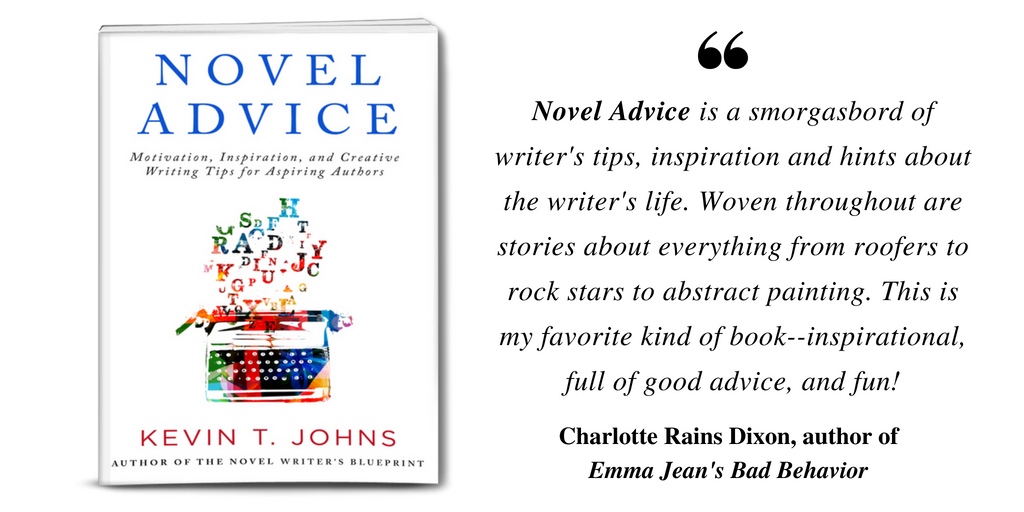
I promise you plant this episode helpful! If so, you lot'll dear my volume Novel Communication: Motivation, Inspiration, and Creative Writing Tips for Aspiring Authors. Take hold of a Gratuitous re-create by clicking the paradigm beneath:
Podcast: Play in new window | Download
Subscribe: Apple Podcasts | RSS
Source: https://www.kevintjohns.com/2018/02/14/writingcoach60/
0 Response to "Best Fiction Books for Writers to Read"
Postar um comentário